2026-08-19
Fear of heights in a high ropes course
Why almost everyone feels fear ten metres up, where the line between ordinary height vertigo and acrophobia runs, and how to plan a visit when you already know it will feel bad up there.
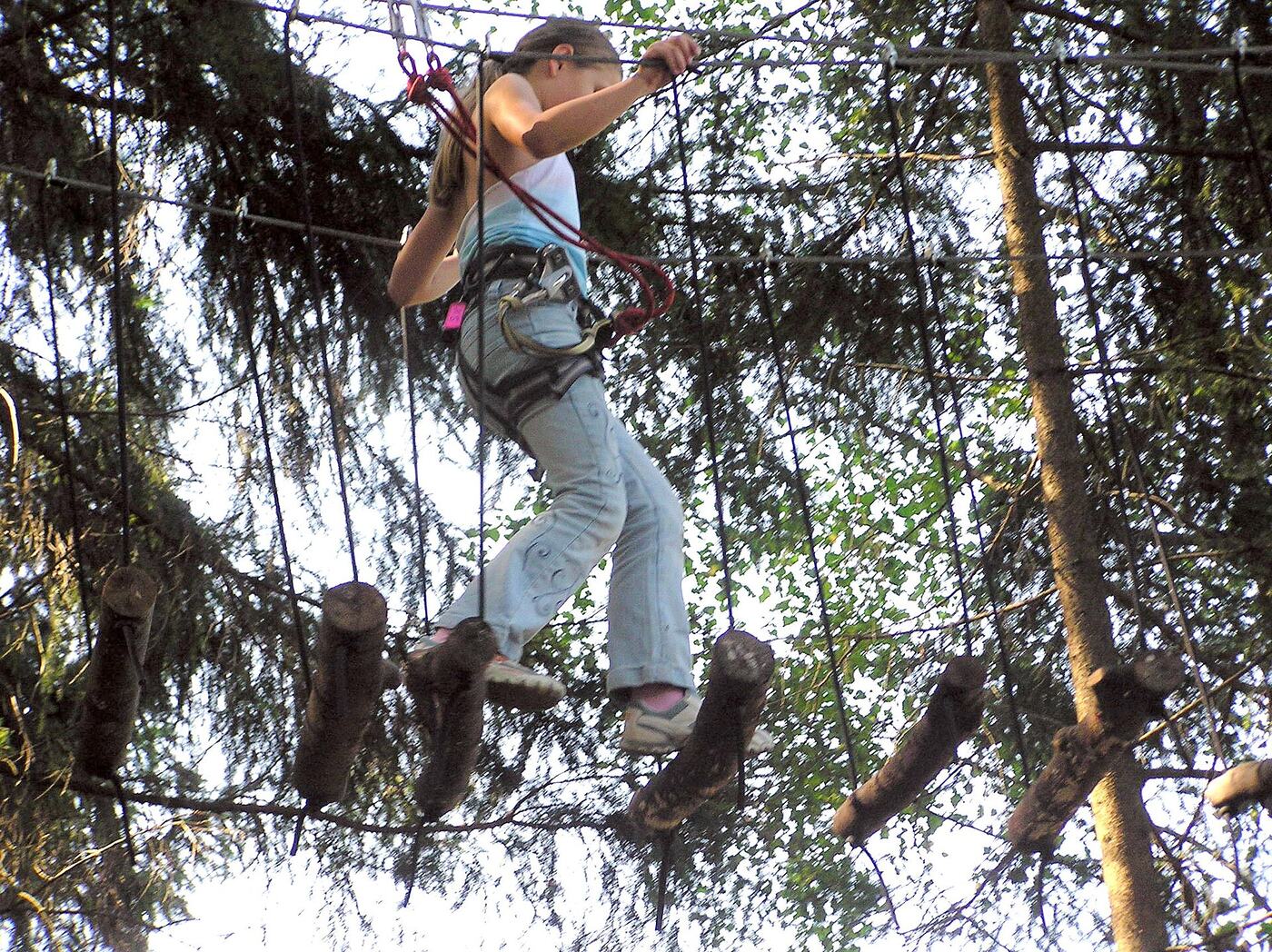
Schubbay, CC BY-SA 3.0
"I'm afraid of heights" is the most common sentence people use to cancel a trip to a climbing park. It is almost always true — and it is rarely a reason not to go. Because what most people mean by it is not an anxiety disorder but a perfectly normal physical reaction, one you can get to know in a high ropes course under controlled conditions.
This article explains what happens in the body, where the line to a phobia requiring treatment runs, and how to plan a visit so that you do not give up after the first course.
Fear of heights is the normal case, not the exception
The dizziness that grips you ten metres up on a swaying beam has a name: height vertigo. It arises because the balance system compares three sources of information — the inner ear, the proprioception of the muscles, and the eyes. Up high, the eyes lack close reference points. The ground is far away, the trees move, and what the eye reports no longer matches what the inner ear and muscles report. The brain answers this contradiction with dizziness and raised muscle tone — you cling on.
That is true of nearly everyone. Anyone who says they have "no fear of heights at all" has usually learned to ignore the reaction, or has not been high enough yet.
Acrophobia is something else: an anxiety disorder in which the mere thought of height triggers panic, where people avoid bridges, cannot look over a stairwell railing, and where avoidance shapes daily life. Depending on the study it affects a low single-digit percentage of the population and belongs in therapeutic hands — not in a forest ropes park.
The practical difference: height vertigo decreases with every round. Acrophobia does not.
What makes a ropes course different from a balcony railing
Three things make a climbing park an unusually good place to deal with height.
First: you are demonstrably attached. Modern sites use continuous belay systems. Two carabiners "communicate" so that both can never be open at once — systems such as Smart Belay or Smart Delay are standard in almost every newer park. So you cannot unclip by accident, not even in panic. That is not reassurance, it is a technical fact, and it helps more than any encouragement.
Second: the height is graded. Nearly every site starts with a briefing course one to two metres up. Then come green and blue courses at three to five metres, then red at eight to twelve, then black above that. You can stop at any point. After every course you are back on the ground and decide again.
Third: there is a way out. Every course ends at a tree with a descent. You do not have to turn back and you do not have to push through.
A one-day format built exactly for this
At the Hochseilgarten Attersee in Seewalchen, Austria, a format combining mental training and climbing starts in September. It is called "Hochgefühl", is run by Elke Pflug and is aimed at healthy adults from 18. No climbing experience is needed, and the group is capped at twelve people per date.
The structure is notable because it reverses the order you normally get in a climbing park: the morning covers mental and breathing techniques plus material from brain research, and in the afternoon what was learned is applied on the course — in exactly the situation it is meant for.
That is the difference from an ordinary visit. Turn up and you get a safety briefing and then you are up there. Book a format like this and you have tools in hand beforehand.
Similar offers exist under names like team training, outdoor education or personal climbing supervision at a whole range of sites. Kletterwald Schwindelfrei in Brühl, for instance, provides a climbing master who accompanies you for two hours for a surcharge.
Seven things that genuinely help the first time
1. Do the smallest course twice. A second run on the same green course achieves more than a first attempt on the blue one. The brain needs repetition, not escalation.
2. Look ahead, not down. The glance at the ground is what triggers the vertigo. Find a fixed point at eye level — the next tree, the next element.
3. Breathe out, not in. Under tension most people breathe in shallowly and hold their breath. Deliberately exhaling longer than you inhale measurably lowers the pulse. That is the solid core of what mental training teaches as breathing technique.
4. Loosen your hands. People cling to ropes they do not need — the harness is what holds you. Consciously letting go saves strength, and lack of strength is the most common reason people stop after an hour.
5. Do not go at the weekend. The pressure from people waiting behind you is considerable. On weekdays or in the last two time slots of the day it is far quieter — some operators even give a discount for it.
6. Book time, not height. Sites with graded time slots — two, three or three and a half hours — are better than day tickets if you do not know how long you will last. At Kletterwald Hennef, for example, you book three or five hours and extend for 3 € per half hour if needed.
7. Bring someone with nothing to prove. The best companion is not the fittest but the most patient. At almost every site spectators pay nothing — so you can bring someone who stays down and waits.
For parents: children are afraid differently
Children often experience height more freely than adults, but they tip over faster. What helps:
- Do not coach from below. Cheering raises the pressure. Standing there calmly helps more.
- Take the age limit seriously. It is not only a question of size but of concentration. A child who constantly needs re-clipping is overwhelmed.
- Check the supervision rules. Many sites require an adult climbing along up to age ten, often at a ratio of one to two or one to three. If you come with four children, check beforehand.
- Children's course first. Sites like Winterberg, Biggesee or Hamm have dedicated areas for the smallest, in some cases from age one or four.
When to skip it
There are cases in which a ropes course is the wrong idea:
- with a diagnosed anxiety disorder, as long as it is untreated
- with cardiovascular disease, epilepsy or severe vertigo of another cause — many operators require a medical self-declaration for this
- during pregnancy; several sites exclude it explicitly
- under the influence of alcohol or drugs, which is forbidden everywhere anyway
And a very practical point: if you actually do feel sick up there, tell the staff. Every site has trainers who can bring someone out of a course. That is routine, not drama — and it happens on every operating day.
Frequently asked questions
Can you get rid of a fear of heights in a climbing park? Height vertigo can be reduced considerably through habituation; that is exactly what the graded difficulty of the courses is built on. A diagnosed acrophobia, by contrast, belongs in therapeutic treatment — a climbing park is no substitute.
How high are ropes courses usually? Most sites range between one metre in the children's area and twelve to 15 metres on the hard courses. A few go higher — the new ropes course in Munich's Olympic Park measures around 22 metres.
Do you have to finish the whole course? No. Every course ends with a descent, and you can stop after each one. You pay for the time, not for the number of elements.
What if I get stuck in the middle of a course? Then the staff get you down. That is what they are there for, and every site has a defined rescue procedure.
Sources: report by meinbezirk.at on the "Hochgefühl" format at Hochseilgarten Attersee (August 2026). Details on belay systems, courses and supervision rules from the respective operators' websites, last checked in August 2026.