2026-08-16
The inclusive high ropes course – climbing with a disability
Since April 2026 Marburg has a high ropes course built for wheelchair users, people with muscular weakness and visually impaired visitors. What inclusive climbing means technically, what it cost and which questions to ask before you go.
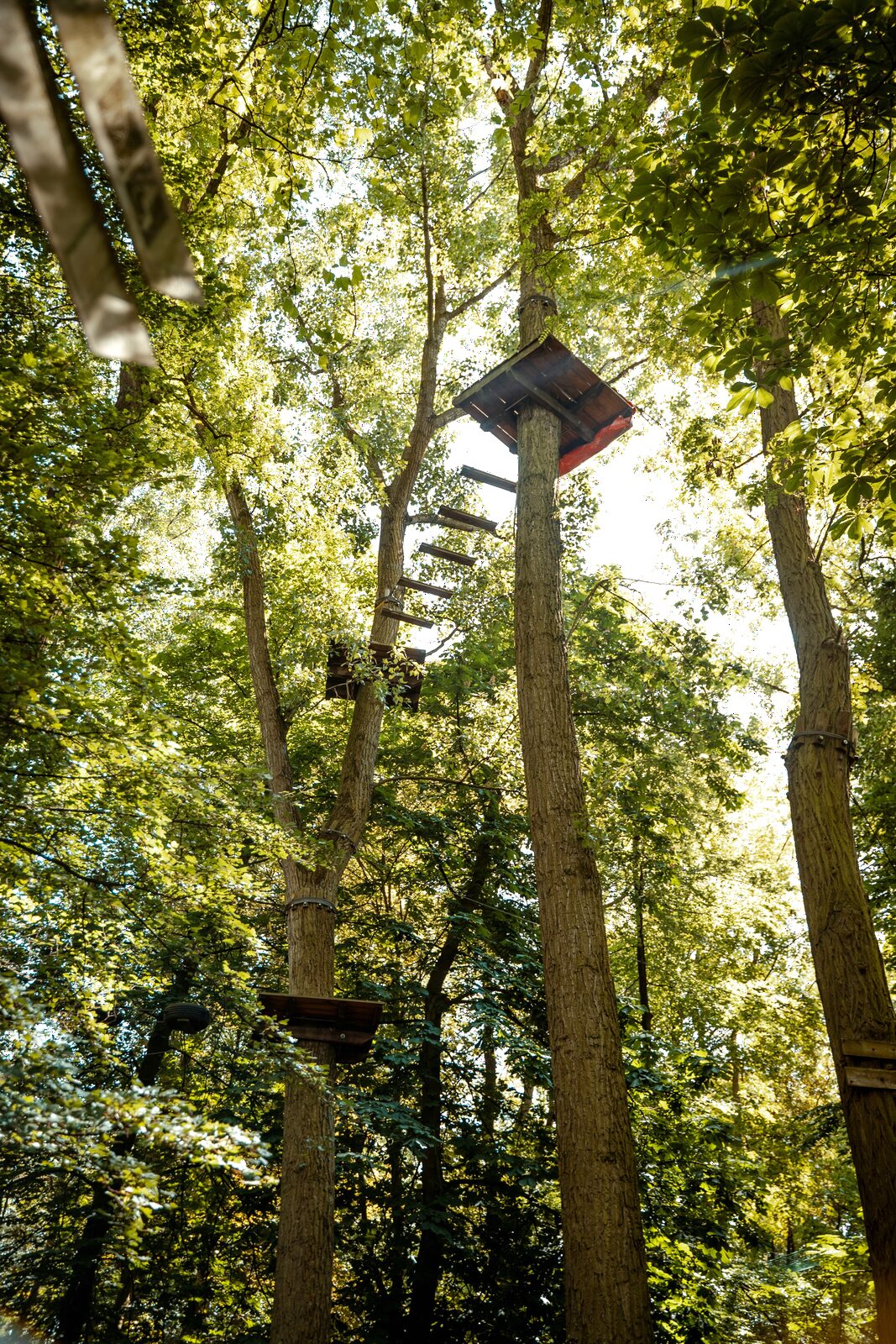
A high ropes course is a place where height, weight and mobility decide who gets in. Almost every operator in this directory states a minimum height, many a weight limit, some require a medical self-declaration. There are safety reasons for all of it — and it systematically excludes part of the population.
Since April 2026 there has been a site in Marburg an der Lahn — the university town in Hesse, Germany, not to be confused with Slovenian Maribor, which was also called Marburg in German — that was planned differently from the start. It is the occasion for this article but not its only subject: anyone who wants to climb with a disability needs concrete information about what is technically possible and which questions to ask in advance.
What was built in Marburg
The course stands on the recreation grounds in the town forest of Marburg in Hesse and is run by the youth services department of the university town of Marburg. It was built by ALEA GmbH. The city invested 272,000 euros, with a further 10,000 euros in funding from the Hessian Ministry for Social Affairs and Integration.
The structure is around six metres high — considerably lower than the 12 to 20 metres common in commercial forest parks. Height is not the point here. The point is how you get up and down again.
Four ways up, four ways down
For the ascent there are:
- a ramp
- rope hoists
- a climbing wall
- a climbing net
For the descent:
- the same ramp
- a rope pull
- a steep ramp taken backwards
- a zipline
This choice is the actual core of the inclusion. A conventional forest park has exactly one way up — a ladder or a net wall — and anyone who cannot manage it never enters the course at all. Four parallel entrances mean a group with very different abilities arrives at the top together instead of splitting up beforehand.
Weight relief for people with muscular weakness
The site has a weight-reduction device. Put simply, a counterweight system takes part of the body weight, so less of your own strength is needed. For people with muscular conditions that is the difference between watching and taking part.
A tactile model for visually impaired visitors
A tactile model represents the structure so that blind and partially sighted visitors can work out the layout in advance. Further tactile elements have been announced.
Both ascent and descent are wheelchair-suitable.
Who can use it
The Marburg course is not a walk-in attraction. It is aimed at groups from schools, clubs, education and training as well as youth and disability services, and is explicitly designed for people with and without impairments. If you want to go, you book as a group.
At the opening the mayor spoke of "unusual, movement-oriented and shared experiences". We find the sentence of one user more remarkable, who said afterwards that it had felt simple and everyday. That is the real benchmark: not the special experience, but the matter-of-factness.
Inclusion is not the same as accessibility
The two terms get used interchangeably, and in a ropes course that causes misunderstandings.
Accessible usually refers to the grounds: parking, a firm path, a toilet, the ticket desk. There are forest parks with an accessible reception that still offer not a single course a wheelchair user could reach.
Inclusive refers to the structure itself: can someone with limited mobility actually climb? That needs different equipment — ramps, counterweights, transfer options — and trained staff.
So when you call, do not ask about "accessibility" but ask specifically:
- How do you get up into the course — ladder, net, ramp, hoist?
- Is there a weight relief system?
- Can I reach the entry platform in a wheelchair?
- Is there staff who assist with transfers?
- How does the rescue work if someone gets stuck up there?
- Is there a ground-level course as an alternative?
The last question is the most practical. Low ropes courses and briefing courses usually sit one to two metres up and can often be used without time pressure. For many groups that is the better entry point than the high course — disability or not.
What else is possible in Austria, Germany and Slovenia
Among the more than 200 sites now in our directory there is no second one built this consistently for inclusion — but there is one that offers it concretely: Waldhochseilgarten Scharbeutz on the Bay of Lübeck has, in course 1, a route that can also be done with a physical or intellectual disability. The operator asks for advance notice so that specially trained staff are on hand.
What else exists, and often gets overlooked:
Sites with very low courses. Where a training or children's course runs one metre up, the entry is easier for many people. Kletterwald Winterberg runs its children's course at one metre, and Kletterwald Haltern has three briefing courses of its own.
Sites that do not charge companions. At many operators only climbers pay — anyone staying on the ground or assisting pays nothing. That matters for personal assistants.
Providers with an outdoor-education focus. Places like Kletterwald Borken have developed group programmes, trainer teams and a seminar room. Such operations can respond to special requirements more readily than a pure self-service site.
Reduced rates with a disability card. Several sites — Bonn, Schwindelfrei in Brühl, Paderborn, Soest, Hamm — grant the reduced rate to disability card holders. That is no substitute for accessibility, but it does indicate they expect the question.
Why this is a topic right now
The Marburg build falls into a period in which accessibility in leisure sport is discussed noticeably more than ten years ago. Part of that is funding policy: without the state grant the site probably would not exist in this form. Another part is construction — modern ropes courses are planned modularly, and a module with a ramp does not fundamentally cost more than one with a ladder if it is designed in from the start.
For operators building or extending, that is the practical lesson from Marburg: the decision is made in the planning, not in operation. Retrofitting a ramp to an existing platform is expensive. Allowing for it during the build barely is.
Frequently asked questions
Can you climb a high ropes course in a wheelchair? At the vast majority of sites you cannot, because entry runs via ladders or nets. In Marburg ascent and descent are built to be wheelchair-suitable. At any other site, ask specifically about the route onto the platform.
Are there reduced rates for people with disabilities? Yes, many operators apply the reduced rate on presentation of a disability card. Companions who do not climb pay nothing at most sites anyway.
What is a low ropes course? A structure one to two metres off the ground, often without harness and rope, secured by the group instead. It is mainly used in outdoor education and is frequently more accessible than a high course.
How do I find a suitable site near me? Our directory filters sites by region, age, height and price. Minimum height is the best first filter — at almost every operator it is the hard limit.
Sources: press release of the university town of Marburg on the opening of the ropes course, hessenschau report of July 2026. Details of individual sites from the respective operators' websites, last checked in August 2026.