2026-08-25
High ropes courses in rain, wind and thunderstorms
Why climbing parks close in thunderstorms, at what wind force they stop, when rain is no obstacle and how to plan a visit that actually happens.
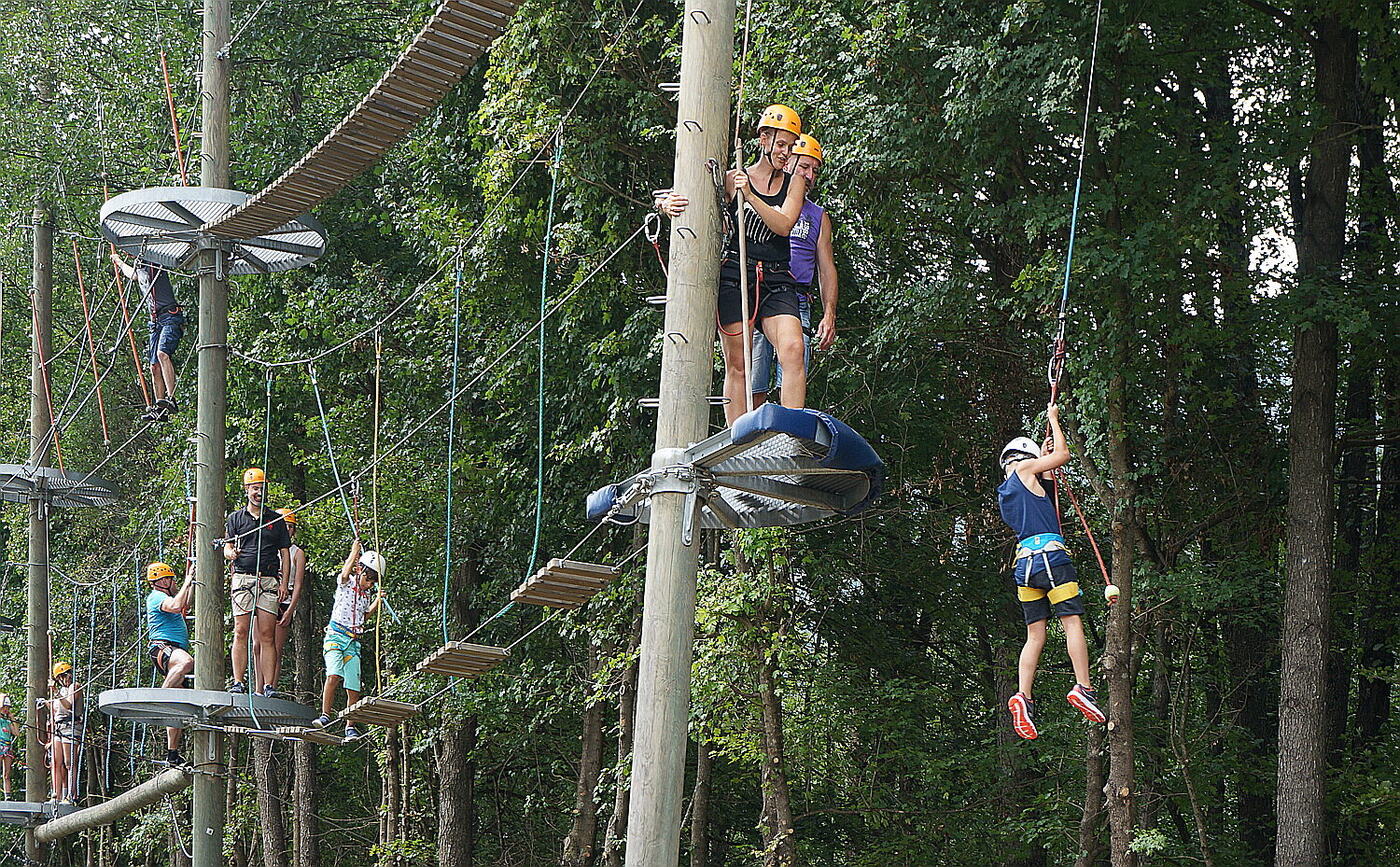
Naturpuur, CC BY-SA 4.0
The AbenteuerPark Kressbronn on Lake Constance reopened on 7 August 2026. A storm had shut the site down for days; only after clean-up, repairs and a safety inspection was climbing allowed again. One course stays closed for now, all the others are open. This is not an exception but the rule: weather is the most common reason a planned visit to a high ropes course falls through – and at the same time the factor you can plan around best, once you know how operators decide.
Anyone who has driven an hour for nothing and stood in front of a closed ticket booth knows the frustration. It can almost always be avoided. Operators do not close arbitrarily, but by fairly clear criteria that differ only in nuance from one site to the next. This piece explains which weather leads to which consequence, what happens to a site after a storm and how to time a visit so that it actually goes ahead.
Why height and weather do not mix
A high ropes course is a structure of steel cables, metal carabiners and platforms four to over twenty metres up. Three properties make it weather-dependent. First, metal conducts electricity, and anyone hanging ten metres up on a taut steel cable is the most exposed point for miles around in a lightning strike. Second, wind grips harder with height: what is a stiff breeze at ground level makes cables and climbers sway noticeably up top. Third, platforms, footholds and handrails turn slippery when wet, which raises the risk of a fall at the transitions.
Not all three of these hazards carry the same weight. Lightning is absolute, wind a matter of degree, wet mostly manageable. Operators' decisions fall out in exactly that order.
Thunderstorms: the one weather with no compromise
In a thunderstorm every serious site closes, without exception and often at very short notice. This is the single point where there is no trade-off: a climber in the safety system cannot be taken off the cable in seconds, and a lightning strike gives no warning. Coastal operators such as Hochseilgarten Eckernförde point out that local storm cells move through quickly and forecasts are unreliable – which is why the decision often comes only on the day itself or even during climbing.
For you this means: a storm in the forecast does not necessarily mean a closed park, but a high risk of a short interruption. If a single cell passes through, operations can resume an hour later. Do not rely on the weather app alone, but on the operator's announcement.
Wind: from force 6 to 8 it stops
Unlike thunderstorms, wind comes on a scale – and operators draw the line differently. Two thresholds are common: some sites reserve the right to stop at wind force 6 (strong wind, 39 to 49 km/h), others only at wind force 8 (gale-force gusts, from 62 km/h). Hochseilgarten Eckernförde, for instance, names force 8 explicitly as its limit for storm gusts.
The range comes down to location and construction. A site in dense forest is more sheltered than a free-standing climbing tower on a meadow or a course on an open lakeshore. If you want to play it safe in unsettled weather, choose a forest ropes park over an exposed site – the tree canopy dampens not only wind but rain as well.
Rain is rarely the problem
Rain is the most overrated disruptor. Most forest ropes courses stay open in light to moderate rain; the canopy keeps off a good deal, and the safety systems work wet or dry. Operators such as Hochseilgarten K1 outside Cologne put it plainly: with the right clothing, climbing is fun in damp weather, and heavier showers can be waited out under cover. Closure comes only with sustained heavy rain, when paths soften and visibility suffers.
In practice: sturdy, grippy shoes and a rain jacket belong in the bag when the forecast is uncertain, not a cancellation. Conversely, the other extreme can also force a closure: some sites, such as Adventurepark Xanten, reserve the right to restrict operations in extreme heat, because metal parts heat up and the strain rises in full sun. On a 35-degree day the early morning is the better choice than the afternoon.
What happens to a site after a storm
The Kressbronn case shows why a site does not simply carry on the next morning after a storm. A storm can throw branches into the cables, damage platforms or endanger whole trees that carry the courses. Before climbing resumes, every course must be checked individually: cable tension, carabiners, anchor points, the condition of the carrier trees. Only what passes the inspection goes back into service.
That is why a site often reopens section by section after a storm. In Kressbronn nearly all courses were open after the reopening on 7 August 2026, one stayed closed – not because the whole park was unsafe, but because that one section was still waiting for its clearance. A closed single course is therefore not a warning sign but the opposite: proof that inspection is done and nothing is signed off wholesale. The AbenteuerPark Immenstaad, the larger sister site on the same lake, works on the same principle.
What you get back if weather cancels your visit
If the operator closes, your ticket is not automatically lost – but the rules differ, and it pays to know them before booking.
- Hochseilgarten K1: for cancellation up to 24 hours before the booked slot, you get either a refund minus 20 percent or a voucher for the full amount.
- Hochseilgarten Ammersee: for cancellation up to 48 hours ahead, 80 percent of the climbing price is refunded as a voucher.
- Kletterwald Schwindelfrei: if the forest has to close for weather, a voucher is issued as long as the booked start time is no more than two hours past.
The pattern behind it is the same everywhere: a genuine short-notice weather closure by the operator is handled generously, a guest's spontaneous change of mind is not. If you want to stay flexible in unsettled weather, book late and check the cancellation terms first rather than paying weeks in advance.
How to plan around the weather
Four simple rules follow from all this. First: the operator's homepage on the morning of the visit is the only reliable source. Weather closures are updated there and on Google immediately, often faster than by phone, which on busy days is rarely reachable anyway.
Second, in a shaky forecast choose a forest ropes park over an exposed site – the canopy shields from wind and rain at once. Third, keep a bad-weather alternative nearby, especially with children. And fourth, on hot days climb early, on stormy ones avoid the afternoon.
A look at the directory helps with the choice: knowing whether a site sits in forest or open ground, whether it has a roof to shelter under and when it opens lets you plan the visit weatherproof from the start. If you are coming with children, our piece on what age children can enter a climbing park gives you the relevant age limits – because a child who is already cold will not climb long in drizzle anyway.
Frequently asked questions
Is a high ropes course open in the rain?
Usually yes. Light to moderate rain is no reason for most sites to close, because the canopy keeps off a lot and the safety gear works wet or dry. Only sustained heavy rain or a thunderstorm forces a closure. With sturdy clothing and grippy shoes a visit in damp weather is perfectly possible.
At what wind force does a climbing park close?
Depending on the site, between wind force 6 and 8 on the Beaufort scale, roughly from 40 to over 60 km/h. Sites in dense forest are more sheltered and close later than free-standing towers or courses on an open shore. Each operator sets the exact limit itself.
Do I get my money back if the park closes for weather?
Usually yes, but as a voucher and under differing deadlines. Common models range from 80 percent as a voucher to a full refund minus a handling fee. A genuine weather closure by the operator is handled generously; check the cancellation terms before booking.
Why is a single course closed while the rest is open?
Because every course is inspected and cleared individually after a storm. A closed section means that part is still waiting for its safety clearance while the checked courses already run. That is a sign of careful inspection, not of a general problem.
How do I know on the day whether it is open?
Through the operator's homepage or its Google entry. Short-notice weather closures are updated there first. A phone call is the worse option, because in a thunderstorm the decision often comes only on the day and the line is barely reachable when it is busy.
Sources: AbenteuerPark Bodensee (operator, August 2026); Hochseilgarten Eckernförde, Hochseilgarten K1, Adventurepark Xanten, Kletterwald Schwindelfrei and Hochseilgarten Ammersee (operators' stated weather and cancellation rules, August 2026).