2026-08-20
High ropes courses with no ticket desk
Around a quarter of the sites in this directory take no walk-in visitors. Why that is deliberate, what those houses can do instead – and how a family still gets in.
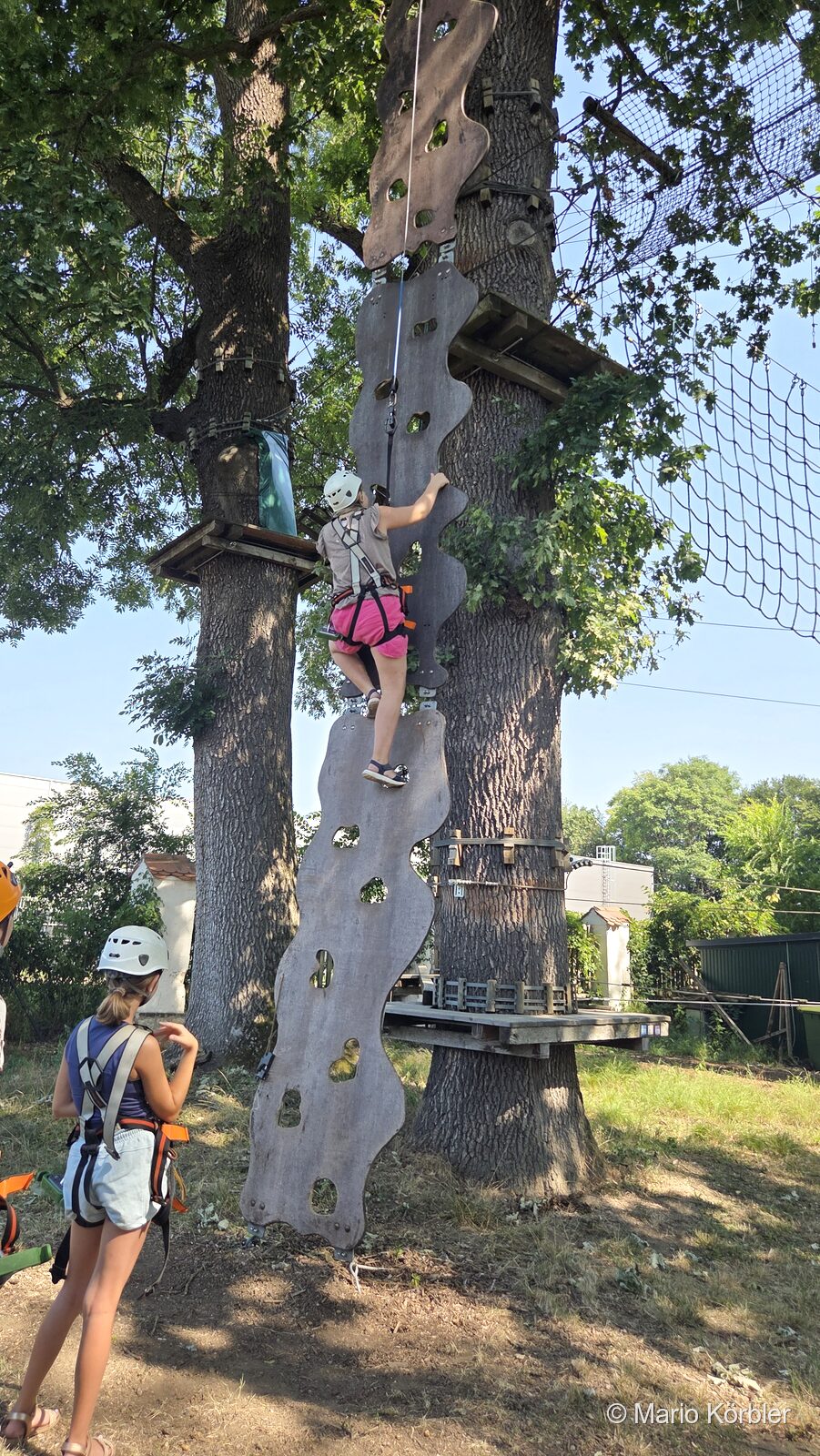
You plan a Sunday outing, find a high ropes course nearby, drive over – and stand in front of a closed barrier. Not because it is shut, but because there never was a ticket desk. No counter, no price list, no turnstile. Anyone wanting to climb had to phone ahead.
That is not an exception. Of the 350 sites in this directory, 85 name no adult price, and 24 of them state expressly that only groups or booked programmes get in. At nine sites both apply: no individual price, no free admission.
This piece explains why these houses exist, what they deliver in return, and how a family or an individual still gets in.
Two business models that barely resemble each other
A climbing forest in the usual sense sells time. You pay 25 €, get a twenty-minute briefing and then set off alone. The site is built for throughput: as many people per hour through as many courses as possible. Hence the self-belay systems that make unclipping technically impossible – they replace supervision.
An adventure-education ropes course sells something else: accompanied time. There a trained instructor stands with the group, often one per eight to ten people. Belaying is frequently mutual – one person climbs, another holds the rope from the ground. That is slower, needs more staff, and is educationally the whole point: you have to rely on somebody.
Both are high ropes courses. The second model simply cannot be sold over a counter.
How to spot them before setting off
The wording on operator sites is remarkably consistent once you know what to look for:
"From ten people" or another minimum number. The Hochseilgarten Jugendscheune Neukloster in Mecklenburg-Vorpommern lets you climb all year, seven days a week and around the clock – but only from ten people upwards. Turn up as a pair and you do not climb.
"By arrangement" instead of opening hours. Where a site gives no times but a phone number, that is usually not a sloppy website but the business model.
Hire instead of admission. Hochseilgarten Dülmen in the Münsterland names no per-person price at all: up to 18 participants, four hours cost 480 €; up to 30 participants, six hours cost 810 €. Instructors are included – over 70 work there.
Booking through a third party. In Dülmen the booking runs not through the ropes course but through the Katholisches Bildungswerk Borken. That is the commonest reason enquiries go nowhere.
The course as part of a stay. At Vysokolanové centrum Resort Březová in Czechia the rope park comes only as a package with accommodation and full board. Two days cost 2,130 to 2,690 crowns – and that covers everything.
What these houses can do in return
Giving up walk-in trade is not a weakness but the precondition for three things a self-service site can barely manage.
They can respond to individual people
The clearest example stands in Wagna in southern Styria. The Hochseilgarten Schloss Retzhof belongs to the Schloss Retzhof education centre, has 28 stations, a flying fox and a viewing platform 18 metres up – and holds the European Accessibility Award. Its adventure stations can be used by people with disabilities too.
That only works because nobody is pushed through by the minute. Planning an inclusive group needs lead time, adapted equipment and staff who know what they are doing. A ticket desk and inclusion do not rule each other out in theory, but almost always in practice.
Similarly Hochseilgarten Hotel FIT in Much in the Bergisches Land: Germany's first zip line for wheelchair users runs there, 80 metres from eight metres up, along with a wheelchair bridge. Booking goes through Natur bewegt e.V., not the hotel.
They can cut the programme to the group
In Neukloster the group picks a scenario in advance – more team experience or more action. At the Hochseilgarten Jugendherberge Rurberg in the Eifel the group decides together with the instructor whether to take the 18-metre course or the climbing tower. At a self-service park the price list decides that.
They can take their time
Where billed climbing time is missing, so is the pressure. The Lanové centrum PROUD Olomouc in Czechia writes simply that the programme has no time limit. There the partner belays from the ground – which is why you have to come at least in pairs anyway.
How a family still gets in
Four routes that work in practice:
Ask whether there are open dates. Many houses set aside individual days in the year when individuals can climb along. That is rarely on the website.
Join an existing group. Schools, clubs and youth groups often do not fill their slots. Asking the operator costs nothing.
Use a birthday as the occasion. Ten children come together quickly, and many of the sites named here run children's birthdays as a listed programme.
Switch to a house that does both. Some run two tracks: weekends with a ticket desk, weekdays for groups. Lanový park Rokytnice nad Jizerou in the Krkonoše has fixed hours in July and August and arranges dates outside them.
What this means for searching this directory
We list these sites deliberately, even though you cannot turn up on the day. Two things follow:
The price filter hides them. Filtering for "up to 20 €" shows only sites with a published price – houses without an individual price drop out. That is intentional: we cannot claim a visit costs a certain amount when the operator names none.
The opening hours field then reads "by arrangement only". That is not missing information. That is the information.
Frequently asked questions
Is a group ropes course more expensive? Per person, usually not. Dülmen at 18 participants works out at around 27 € for four hours with an instructor team – within the range of an ordinary climbing forest ticket. The difference is that you have to assemble the group.
Can I climb as an individual at all? At most of these houses only if an open date is running or a group comes together. Asking is still worth it – the minimum number is often a costing threshold, not a safety rule.
Why do these sites publish no prices? Because there is no single price. Costing a programme by instructor team, duration and group size produces an offer, not a figure.
Are they smaller than commercial climbing forests? Not necessarily. The Retzhof has 28 stations and a platform at 18 metres, and Rurberg reaches 18 metres too. What is missing is the throughput, not the site.
How do I tell before setting off that there is a ticket desk? By a published price list with individual prices and by concrete times. If both are missing and a phone number stands there instead, it is a group operation.