2026-08-08
Forest rope park
In a forest rope park the courses hang in living trees. That brings shade in the heat and shelter in the rain – and places particular demands on construction and upkeep.
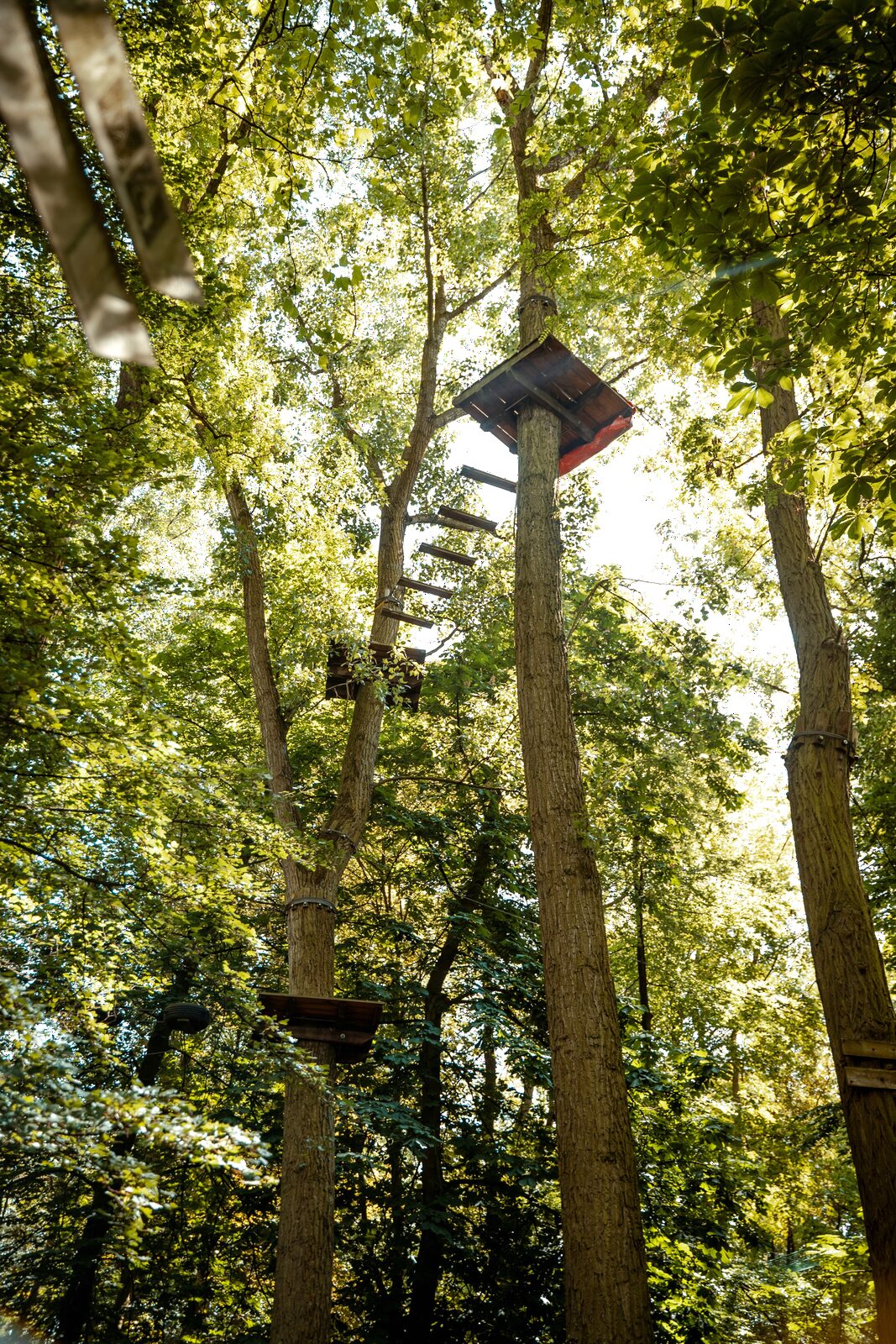
Forest rope park, forest rope garden, climbing forest: all three mean the same thing – a site whose platforms hang in living trees rather than on poles. It sounds like a detail but makes a noticeable difference in practice.
The tree as a structural part
A tree grows, sways in the wind and changes its girth. You cannot simply bolt platforms into it. Modern sites therefore use systems that wrap around the trunk and can grow with it without damaging the bark – the nutrient channels sit directly beneath it.
That means ongoing work visitors never see: fixings have to be adjusted regularly, unhealthy trees are taken out of the course, and the site changes over the years with the stand. A forest rope park is never quite finished.
The European standard EN 15567 covers both construction and recurring inspection.
What the forest changes for visitors
Shade. The most practical advantage. While open sites turn into heat traps in high summer, it stays pleasant under the canopy. Hochseilgarten Stegerspark in Burgenland explicitly advertises shade until 2 pm.
Rain. Light rain matters little in the forest – the leaves catch much of it and the steel cables do not turn slippery. In a thunderstorm or strong wind every site is cleared regardless.
Orientation. Between trunks you rarely see the whole course, which takes some of the sting out of a fear of heights because branches interrupt the view down.
Season. That is why most forest rope parks run from May to October: without leaves there is no shade, and maintenance falls into the winter months.
Where the setting makes the difference
- By a lake. Kletterwald Ossiacher See sits in old beech woodland overlooking the water – climbing and swimming on the same day.
- Above a gorge. At Waldseilpark Tscheppaschlucht the courses cross the torrent; the longest flying fox runs 300 metres.
- On the mountain. Waldseilgarten Hirschenkogel sits at 1,350 metres right by the top station – noticeably cooler than the valley on hot days.
- In a pine forest. X-Trees Serfaus spreads 13 courses over more than 1,000 metres.
- On historic ground. OCHYS Waldfreizeitpark stands in an old oak stand on a Celtic ringwall settlement – with cabins to sleep in among the treetops.
What to watch with children
Forest rope parks are usually built lower than pole-based sites – not out of caution but because trees are more stable near the ground. For families that is an advantage: entry courses often sit at one to three metres, so parents can accompany from below.
As everywhere, height usually decides rather than age. Why that is so is explained in the FAQ.
Sturdy shoes matter more here than elsewhere: the ground between courses is forest floor – roots, bark mulch and mud after rain.
Every forest rope park in Austria and Slovenia is in the directory, filtered by region, age, height and price. What separates the terms is covered in the piece on the climbing park.