2026-08-12 · Updated on 2026-08-14
Climbing park: visit, prices and age limits
What a climbing park is, how a visit works, what it costs and from what age children may climb – with figures from 79 facilities in Austria.
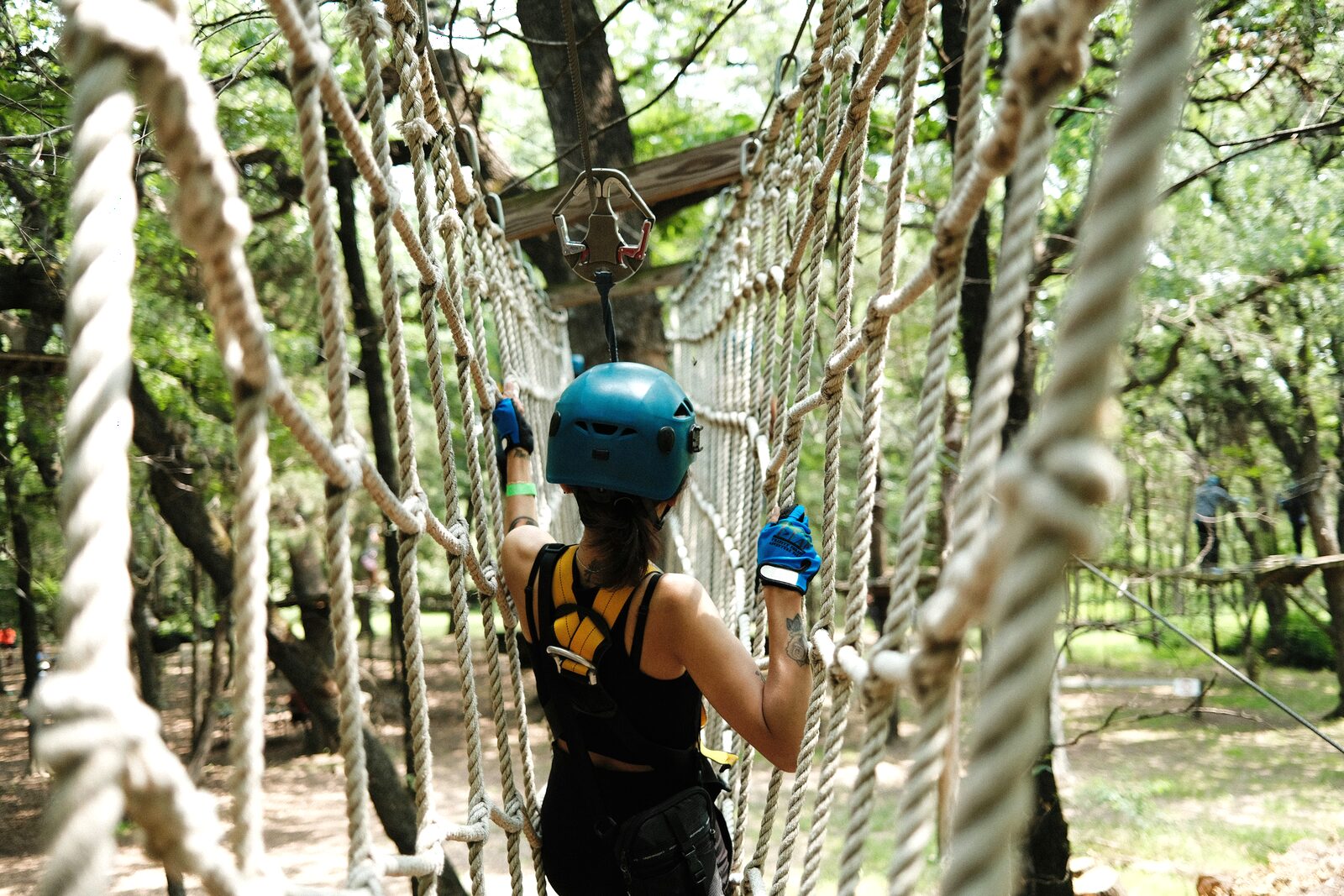
Anyone planning a trip quickly runs into several different words for what looks like the same thing: climbing park, high ropes course, forest rope park, adventure park. Here is what a climbing park is, how the terms differ, how a visit works and what prices, age limits and opening times to expect. The figures come from the 91 facilities in this directory – 79 of them in Austria.
What is a climbing park?
A climbing park is a built installation where you climb from platform to platform on a belay – usually between trees, sometimes on poles or across rock. The links between platforms are called exercises or stations: rope bridges, swinging logs, nets, beams, zip lines.
Several stations in a row make up a climbing course. Courses are colour-graded like ski runs: green and blue are easy and low, red medium, black hard and high. A mid-sized site has six to ten courses; the largest in Austria – the Abenteuerpark Gröbming – has 22 courses with around 200 stations and more than 2,000 metres of climbing.
You walk the courses on your own, not in a guided group. Beforehand there is a compulsory briefing of 15 to 30 minutes covering harness, carabiners and behaviour. That is what separates a climbing park from a via ferrata or a climbing gym: the belay is built into the structure, you only have to operate it correctly.
The terms compared
| Term | What is meant |
|---|---|
| Climbing park | The most general term, used for any of these installations |
| High ropes course | Emphasises height; originally from experiential education, often with instructors |
| Forest rope park / climbing forest | The platforms hang in living trees rather than on poles |
| Adventure park | Usually a climbing park plus extras: summer toboggan run, zip line, petting zoo |
| Climbing course | Strictly a single route inside the site, colloquially the whole site |
For planning that means: the words are not a reliable distinction. Whether a site suits your group is shown by the number of courses, the age limit and the height – not by its name. More on this in the separate articles on the high ropes course in Austria and the forest rope park.
How a visit works
- Arrive and register. Ticket desk, form, and for minors a parental consent slip. Some sites take cash only – Hochseilgarten Stegerspark in Burgenland and Hochseilklettergarten Gänsehäufel in Vienna, for example. Worth knowing before you set off.
- Collect the gear. Harness, helmet, belay set. This is almost always included in the ticket price. Gloves are sometimes compulsory, sometimes an extra for around 5 €.
- Briefing. 15 to 30 minutes on a practice course near the ground: clipping in, clipping out, zip line, what to do if something goes wrong. Nobody goes up without it, prior experience or not.
- Climb. You start on an easy course and work your way up. Most sites limit the ticket – two to three hours from the briefing is common.
- Return the gear. Harness and helmet back, done.
Allow half a day overall. For the big sites such as Gröbming or Adventurepark Gerlitzen half a day is not enough if you want to see everything.
How the belay works – and why it matters most
Two systems are common in Austria:
- Continuous belay. You clip in once at the entry and stay clipped in to the end of the course; unclipping is mechanically impossible. Such systems are called SafetyLine, Safety-Line or Speedrunner and are used at Abenteuerpark Gröbming, Kletterpark Schöckl, Kletterpark Brandnertal and Waldseilpark Tscheppaschlucht, among others.
- Two carabiners to move over. The classic setup: two carabiners, one of which must always stay clipped in. Modern versions such as Smart Belay make it impossible to open both at once – at XP Abenteuerpark Jerzens, for instance.
For families the difference is decisive. With a continuous belay a child cannot make the handling mistake that is theoretically possible when moving carabiners. That takes a lot of tension out of the day – Waldseilpark Pyramidenkogel drops the age limit entirely because of it and goes by height alone.
Construction and inspection follow the European standard EN 15567: part 1 covers the structure, part 2 operation including recurring inspection. If you want to know how seriously an operator takes it, ask for the date of the last inspection – reputable sites answer without hesitation.
What a climbing park costs
This directory records an adult price for 59 of the 79 Austrian sites, which gives a realistic picture:
| Adults | Children | |
|---|---|---|
| Cheapest site | 13 € | 7 € |
| Median | 29 € | 19 € |
| Most expensive site | 54 € | 37 € |
The median of 29 € is the most reliable figure: half the sites are below it, half above. A family with two children therefore typically pays around 95 € for a visit.
At the bottom end sits Waldkletterweg Faistenau in Salzburg at 13 €, at the top Waldseilpark Pfunds in Tyrol at 54 €. Regional differences are smaller than you would think: the median is 29 € in Carinthia, Salzburg and Vorarlberg, 30 € in Styria and Upper Austria, and highest in Vienna at 34.50 € – there is simply no cheap rural site there to compete.
What drives the price: the number of courses, the height, whether a long zip line is included and whether the site hangs off a mountain railway whose ride is often charged separately. Loyalty and season tickets help – at Kletterpark Schlossberg Lienz every fourth visit is free and the season ticket starts at 64 €.
From what age, from what height?
Operators measure differently. This directory records a minimum age for 45 sites and a minimum height for 43 – often both at once.
- By age. The most common value is 3 years (ten sites), followed by 4 and 6. The lowest of all is Kletterpark Schlossberg Lienz, whose Kidspark takes two-year-olds close to the ground.
- By height. By far the most common value is 110 cm (20 sites), then 120 cm. The reason is practical: the child has to operate the belay, or at least hang safely from the steel cable, and reach from platform to platform.
Two further rules apply almost everywhere: under 14 an adult climbs along, often at a ratio of one adult to no more than three children. And many sites set a maximum weight, typically 100 to 120 kg. Details and the sites with the lowest limits are in the article climbing park with children.
Season, weather and time of day
Climbing parks are summer businesses. Of the 43 sites with recorded opening times, most start in May, a few as early as April; they close in October, some at the end of September. There are outliers both ways – Kletterpark Piber in Styria only opens from early July to mid-September.
Three things that make or break the day:
- Last briefing. It is often two hours before closing. Arrive at 4:30 pm at a site that closes at 6 pm and you will still find the desk shut.
- Thunderstorms. Lightning means evacuation, no discussion. In light rain climbing usually continues – wet wood and wet cables are more slippery, but the belay still works.
- Weekdays. Outside July and August many sites open at weekends only.
Always check the current state with the operator. Every detail page in this directory carries the link, along with coordinates and the month in which we last checked the figures.
What to bring
- Firm, closed shoes – sandals and flip-flops are turned away
- Close-fitting long or at least knee-length clothing, nothing loose
- Long hair tied back, rings and necklaces off
- Gloves if the operator does not supply them (thin gardening gloves will do)
- Water and a snack – most courses do not end at kiosk height
- Sun protection at open sites; in the forest it matters less
Finding a climbing park near you
The sites are spread very unevenly across Austria. Tyrol leads with 21 climbing parks ahead of Styria (13) and Carinthia (12); at the other end are Burgenland and Vorarlberg with three each, and Vienna, where only two of three recorded sites are still running.
Tyrol · Styria · Carinthia · Lower Austria · Upper Austria · Salzburg · Burgenland · Vorarlberg · Vienna
On the home page all sites can also be filtered by the child's age, by price and by opening day, and shown on the map.
Frequently asked questions about climbing parks
How long does a visit to a climbing park take?
With registration, briefing and gear, allow three to four hours. Actual climbing time is usually two to three hours – which is also how long the ticket is valid at many sites. At the largest parks such as Gröbming half a day is only enough if you pick a selection.
What does a climbing park cost in Austria?
Adults pay 29 € on median, with a range from 13 € to 54 €. Children pay 19 € on median. Equipment is almost always included; the mountain railway to the park rarely is.
From what age can children go to a climbing park?
Most commonly from 3 years in dedicated children's courses, and from 6 years or 110 cm for the regular courses. A few sites let children climb near the ground from the age of 2, while others require 140 cm for the hard courses. Under 14 an adult climbs along almost everywhere.
Do you need experience or strength?
Experience no, some strength yes. The briefing covers everything you need. Green and blue courses ask for no more than everyday fitness; red and black courses demand grip strength and stamina in arms and shoulders. If you want the thrill without the effort, a pure zip line is the better choice.
Do you have to book a climbing park in advance?
Usually not for individuals – you arrive, buy a ticket and join the next briefing. Groups of eight to 15 and above are asked to book almost everywhere, because the briefing cannot otherwise be handled. In peak season, and at sites with a short season, a phone call is still worthwhile.
What happens when it rains?
In light rain climbing continues; in a thunderstorm the site is cleared. Some operators close during prolonged rain or issue a replacement ticket. Refunds are the exception – ask how the operator handles it before you buy.
What is the difference between a climbing park and a high ropes course?
In practice usually none: both words describe the same kind of site. Historically the high ropes course comes from experiential education and works with instructors and groups, while the climbing park is a public operation with a ticket desk. Some Austrian sites still work in the original sense – see the article on high ropes courses in Austria.
Can you visit a climbing park if you are afraid of heights?
Yes, with the right choice of site. Platform height is what counts: there are courses one to three metres up where the ground stays within reach. Hochseilklettergarten Gänsehäufel in Vienna stays below eight metres overall, while other sites build up to 27 metres. If you are unsure, walk the practice course first and decide afterwards.