2026-08-13
Climbing course: layout and difficulty
How a climbing course is built, how to read the colours from green to black, and how to find the course that suits your own group.
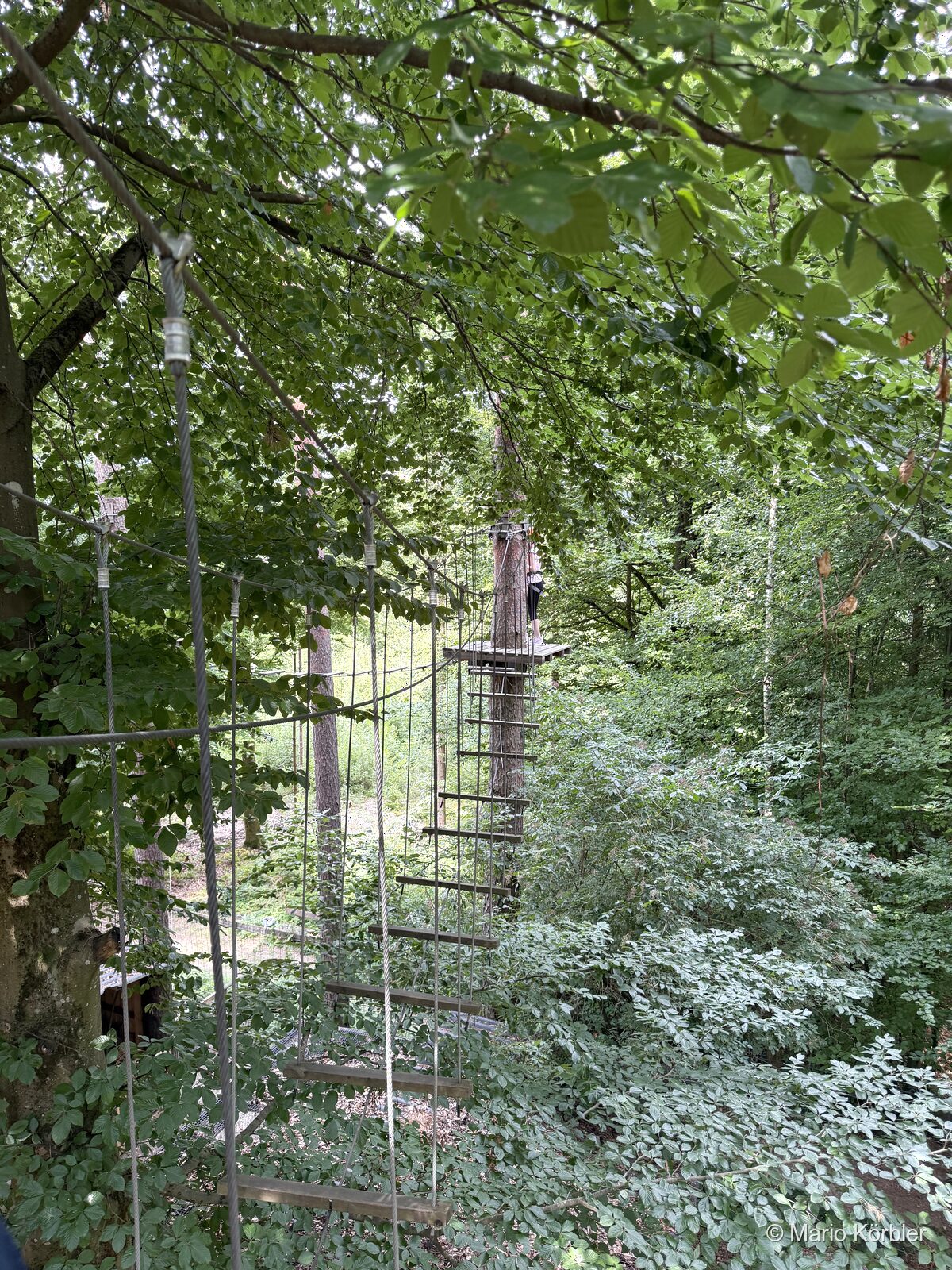
The climbing course is the real unit of measurement in a climbing park. Not the number of trees, not the height, not the area: how many courses there are, what colours they carry and how they relate to each other decides whether a day out works. This article explains the layout, the colour scale and the choice – and why families with children of different ages should look particularly closely.
What is a climbing course?
A climbing course is a connected route through the site: you enter by a ladder or staircase, work your way across several stations from platform to platform and climb down at the end. Getting off in between is usually impossible – the course is a one-way street.
That gives the word two meanings which get mixed up in everyday use:
- Strictly a climbing course is a single route inside a climbing park. A mid-sized site has six to ten of them.
- Colloquially "climbing course" often means the whole site – the way "piste" is sometimes used for an entire ski area.
The building blocks of a course are called stations, exercises or elements. Waldseilpark Tscheppaschlucht in Carinthia spreads 87 elements over eight courses; Waldseilpark Kahlenberg in Vienna has around 150 exercises on 15 courses. As a rule of thumb: eight to fifteen stations make a course, which is 15 to 30 minutes of climbing.
How a course is built
Three parts repeat in every climbing course:
- The platform. A wooden deck on a tree or pole. Here you stand safely, change elements and wait for the person ahead. Only one person should be on a platform at a time – this is the most common bottleneck in the park.
- The safety cable. A steel cable above head height that runs the whole course. You hang from it with the belay set, whatever your feet happen to be doing.
- The station. The link between two platforms – and the part it is all about.
Common types of station and what they demand:
| Station | What you do | What it takes |
|---|---|---|
| Rope or suspension bridge | Walk on boards or ropes, hold the lines | Balance |
| Nepalese bridge | Walk one rope, hold two higher ones | Balance, nerve |
| Wobbly beams and logs | Balance across hanging, swinging timber | Balance, core |
| Nets and spider webs | Climb, crawl, pass through | Whole body, stamina |
| Rings, hoops, stirrups | Move from grip to grip, hanging free | Arm and grip strength |
| Tarzan swing, leap of faith | Let go and jump into rope or net | Nerve |
| Flying fox / zip line | Clip in, lift your feet, roll | Nothing – that is the reward |
Kletterpark Schöckl near Graz has two of the stations at which groups typically split up: the Tarzan swing on the black course and the "leap into the void" from around seven metres.
The colour scale from green to black
Climbing courses are colour-graded like ski runs. There is no Europe-wide standard, but this order has become established in Austria:
| Colour | Typical height | Demand | For whom |
|---|---|---|---|
| Violet, purple, orange | 0.5 to 1.5 m | Playful, often without a harness | Toddlers, first-timers |
| Green | 1 to 3 m | Wide steps, short gaps | Children from about 100–110 cm |
| Blue | 3 to 6 m | First wobbling elements | Families, beginners |
| Red | 6 to 12 m | Grip strength, longer exercises | Experienced, from about 130 cm |
| Black | 10 to 20 m | Hanging, jumps, little foot contact | Sporty visitors, from about 140 cm |
Important: the colours apply within a site, not between sites. A red course in a family park can be easier than a blue one in a sport-oriented park. And some operators grade more finely – the Abenteuerpark Gröbming distinguishes seven levels from violet to black, and Woodland Hochseilpark in Salzburg puts four intermediate steps between "two metres" and "twelve metres with a zip line" instead of the usual one or two.
Many sites tie the colour directly to height. At Kletterpark Schöckl it is 100 cm for green and blue, 130 cm for red and the fun course, 140 cm for black.
How many courses a site has – and what that means
| Site | Courses | Notable |
|---|---|---|
| Abenteuerpark Gröbming | 22 | Largest in Austria, 7 difficulty levels |
| Kletterpark Schlossberg Lienz | 18 | Kidspark from age 2, three levels above |
| Waldseilpark Golm | 17 | Largest in Vorarlberg, Zwergle course without a height limit |
| Waldseilpark Kahlenberg | 15 | Largest in eastern Austria, partly 20 m up |
| Waldseilpark Tscheppaschlucht | 8 | 87 elements above the gorge |
| Kletterpark Piber | 7 | Children's course from age 4, the rest from 140 cm |
More courses does not automatically mean more fun. What counts is how many of them are open to your own group. At Piber a four-year-old climbs exactly one course while the rest of the family has six to choose from – knowing that in advance changes the plan.
It also works without any course structure at all: Waldkletterweg Faistenau in Salzburg is built as a continuous path of around 800 metres with 70 stations, colour-graded rather than divided into loops. At 13 € it is also the cheapest site in the directory.
How the belay works
On a course you either hang in a continuous system – clip in once, stay clipped in to the exit, unclipping mechanically impossible – or in two carabiners you move over at each platform, one of which must always stay clipped. Modern move-over systems (Smart Belay) cannot be opened both at once.
For children the continuous belay is the more relaxed option. Waldseilpark Pyramidenkogel drops the age limit entirely because of it and lets anyone from 120 cm climb. Either way, construction and inspection follow the standard EN 15567.
Choosing the right course
- Start at the bottom. Even experienced climbers walk an easy course first – not for the difficulty but to learn the logic of the site: where to clip in, how the zip lines are built, how much the gear swings.
- Ration your strength. The second red course feels distinctly harder than the first. If you plan to stay three hours, put the black one in the middle, not at the end.
- Spare your hands. Most people give up because of their forearms, not the height. Gloves help, and so does not clutching the ropes permanently but letting the feet do the work.
- Clarify the exit. Before entering a hard course, ask what happens if you cannot go on. Reputable operators have an answer and a rescue plan.
- Watch the clock. The last briefing is often two hours before closing, and tickets frequently last only two to three hours. At Tscheppaschlucht the operator reckons with 2.5 hours plus the briefing.
Finding climbing courses in Austria
On the home page all 91 sites can be filtered by region, by the child's age, by price and by opening day; every detail page lists the number of courses, heights, minimum age and minimum height as far as the operator provides them. Straight to the provinces:
Tyrol · Styria · Carinthia · Lower Austria · Upper Austria · Salzburg · Burgenland · Vorarlberg · Vienna
Frequently asked questions about climbing courses
How long does a climbing course take?
A single course takes 15 to 30 minutes depending on its length. For a visit with several courses, allow two to three hours of climbing plus 15 to 30 minutes for the briefing. Many tickets are limited to exactly that window.
What do the colours on a climbing course mean?
They indicate difficulty, much like ski runs: violet and green are low and playful, blue is the family standard, red demands grip strength, black means hanging and jumping high up. The scale only applies within one site – "red" is not the same everywhere.
Can you abandon a climbing course halfway?
Only to a limited extent. Most courses have no exit in the middle because every platform hangs in a tree. Anyone who cannot continue is recovered by the staff – hence the rule to start easy and ration your strength.
What height do you need for a climbing course?
The most common figure in Austria is 110 cm, followed by 120 cm. For red and black courses many sites require 130 to 140 cm. A few children's courses have no limit at all because they run just above the ground. Details are in the article on climbing parks with children.
How many courses can you manage in a day?
Four to six with normal fitness, provided they are not all in the red range. The limit is usually set by your forearms, not your cardio. At the big sites with 15 or more courses the point is not to walk them all but to pick well.
What is the difference between a course and a station?
A station is a single element between two platforms – a rope bridge, a net, a beam. A course is several stations strung together into one continuous route. When an operator advertises "200 stations", that does not mean 200 courses but typically 15 to 25.