2026-08-14
Zip lines in Austria: sites and prices
Where to find zip lines and flying foxes in Austria – from 2.5 km at the Stoderzinken to the short park run, with prices, weight and height limits.
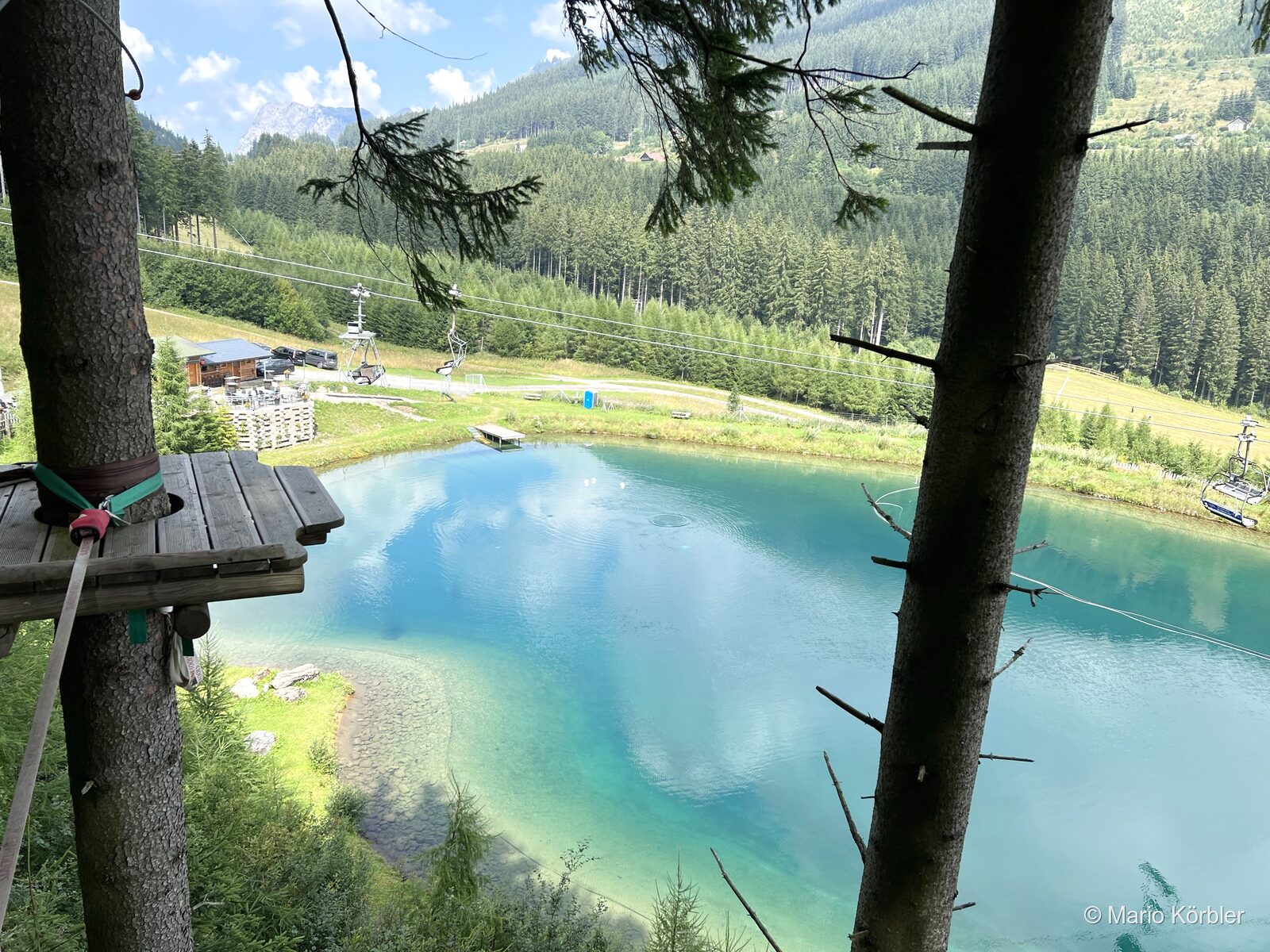
For many people the zip line is the real reason to visit a climbing park: clip in, lift your feet – the rest happens by itself. Austria has them in two very different forms, and confusing the two means queueing at the wrong desk. This article sorts both out and lists the lengths, the prices and – more important than most people expect – the weight limits.
Zip line, flying fox, Seilrutsche: the same thing?
Yes. The thing itself never changes: a steel cable strung between two points, a trolley, a harness, gravity. Only the words differ.
- Flying fox is the common term in Austria and Germany, above all for the zip lines inside a climbing park.
- Zip line is the international term that has taken hold for the big standalone installations.
- Seilrutsche is the plain German translation, Seil-Gleitfluganlage the technical one.
No difference in meaning follows from that – but a rule of thumb does: where the sign says "zip line", the installation is usually long and bookable on its own; where it says "flying fox", it usually belongs to a climbing course.
Two types – and the difference matters
Type 1: the zip line inside a climbing park. It is one station among many, usually at the end of a course. You pay the normal climbing ticket, there is no separate journey, and the length is between 40 and 300 metres. To reach the zip line, you have to climb to it.
Type 2: the standalone zip line. This is not a climbing site: you are strapped in, positioned and launched. No strength required – which makes it exactly right for the people who would struggle with the exercises of a climbing park. In return the weight and height limits are stricter, and there is no easier alternative if you do not meet them.
Two Austrian sites are pure zip lines: the Zipline Stoderzinken in Styria and the GipfelLiner Königsleiten in Salzburg. Hochseilpark Nockberge in Carinthia sits in between: its two 300-metre lines can be flown for 20 € without doing the courses.
The longest zip lines in Austria
| Site | Province | Length | Notable |
|---|---|---|---|
| Zipline Stoderzinken | Styria | 2,500 m | Two sections, 65–115 km/h, up to 161 m above ground |
| Kletterwald Hornpark | Tyrol | 530 m | Flying fox course across the lake |
| GipfelLiner Königsleiten | Salzburg | 430 m | Starts at 2,300 m, 65 m of descent |
| AREA 47 | Tyrol | 400 m | On the 27 m climbing tower, from age 12 |
| Kletterpark Piber | Styria | 300 m | With intermediate platforms, flown in stages |
| Waldseilpark Tscheppaschlucht | Carinthia | 300 m | Across the gorge |
| Hochseilpark Nockberge | Carinthia | 2 × 300 m | Bookable separately, without climbing |
| Abenteuerpark Zillertal Kaltenbach | Tyrol | 180 m | Across the gorge, on the extreme course |
| ACS Alpincenter Flachauwinkl | Salzburg | 150 m | Straight across the Winkler bathing lake |
| Natur-Hochseilgarten Kramsach | Tyrol | 150 m | Followed by a jump from 17 metres |
| Hochseilgarten Zillertal Finkenberg | Tyrol | 3 × 120 m | Across the Zemm gorge |
| Kaolinum Hochseilgarten | Upper Austria | 120 m | Starts twelve metres up |
| Kletterwald Tannheimer Tal | Tyrol | > 100 m | Up to 25 metres above ground |
| Waldseilpark Pfunds | Tyrol | 100 m | Across the Inn, back on foot |
| Hochseilgarten Großraming | Upper Austria | up to 100 m | Nine flying foxes in the Enns valley |
For some sites the argument is quantity rather than length: Adventurepark Gerlitzen in Carinthia has 31 flying foxes and Hochseilklettergarten Gänsehäufel in Vienna 26 – there you change trees flying more often than climbing. A fuller ranking is in flying fox and zip line – the longest in Austria.
Across the border: Soča Fun Park in Slovenia runs a 550-metre zip line in both directions for 15 €, and Družinski park Stari Vrh totals 1,200 metres of zip line, the longest single run measuring 250 metres.
Weight and height: the limits people fail on
Climbing is mostly governed by height; on a zip line it is weight – and in both directions. Too light means stopping halfway along the cable and having to be recovered. Too heavy means the brake is not designed for you.
| Site | Limits |
|---|---|
| Zipline Stoderzinken | from age 8, launch weight 30–125 kg, under 14 accompanied |
| GipfelLiner Königsleiten | from 140 cm, launch weight 50–110 kg |
| Kletterwald Hornpark | flying fox 40–90 kg, 120 kg maximum overall |
| Hochseilgarten Hinterstoder | flying fox across the Steyr from 40 kg |
| Soča Fun Park (SI) | launch weight 25–125 kg |
The practical consequence: an average eight-year-old weighs 25 to 30 kilos and therefore misses the lower limit at many sites. At the GipfelLiner it is 50 kg – primary-school children simply cannot go. If you are travelling with children, settle this before you set off, not at the ticket desk.
What a zip line costs
With type 1 the zip line is part of the ticket – the median Austrian climbing park charges 29 € for adults and 19 € for children. Standalone zip lines bill differently:
| Site | Adults | Children |
|---|---|---|
| GipfelLiner Königsleiten | 17 € | 8.50 € |
| Hochseilpark Nockberge, flying fox only | 20 € | 20 € |
| AREA 47, flying fox | from 31 € | from 26 € |
| Zipline Stoderzinken | 42 € | 27 € (up to 15) |
At the Stoderzinken the shuttle to the start is included – at mountain sites that is not a given, and the cable car often comes on top. In the Nockberge the flying fox added to a climbing ticket costs only 10 €.
How a zip line flight works
- Weighing and registration. At the large sites you really are weighed, not estimated.
- Harness and helmet. A full-body or sit harness, usually with gloves.
- Instruction. Body position, braking, landing. On a pure zip line this takes only a few minutes; in a climbing park it is part of the general briefing.
- Launch. You are clipped in, sit back into the harness and lift your feet. Pushing off actively is expressly unwanted at most sites.
- Landing. Large installations brake automatically with an eddy-current or spring brake; smaller ones use a counter-slope that rolls you out by itself. Where you brake yourself with a gloved hand, the briefing shows exactly how – grip there and nowhere else.
The flight itself is shorter than you expect: even the 2.5 kilometres at the Stoderzinken are over in a few minutes at 65 to 115 km/h.
Season, weather and wind
Zip lines are summer businesses like the climbing parks: most run from May to October. The Zipline Stoderzinken operates from 14 May to 1 November in 2026, the GipfelLiner only from 27 June to 6 September – operating days vary by period.
The extra factor with zip lines is wind. Crosswind changes the flight line and the braking, so exposed installations shut down in gusts even in sunshine. Thunderstorms clear the site anyway. Before a long drive, a phone call the same morning pays off.
Finding zip lines by province
Most zip lines hang where most climbing parks stand:
Tyrol · Styria · Carinthia · Salzburg · Upper Austria · Lower Austria · Vorarlberg · Burgenland · Vienna
Every detail page in this directory lists the length and character of the zip lines as far as the operator states them, plus coordinates, map and a direct link to the operator.
Frequently asked questions about zip lines
Where is the longest zip line in Austria?
At the Stoderzinken in Styria: 2.5 kilometres in two sections, up to 161 metres above the ground and at 65 to 115 km/h. Its operator – the same as at Abenteuerpark Gröbming in the valley – calls it the largest gliding cable installation in the Alps.
What does a zip line cost in Austria?
Standalone zip lines cost between 17 € and 42 € for adults. Inside a climbing park the zip line is included in the ticket, which costs 29 € on median. Surcharges for individual mega flying foxes run from about 10 € to 20 €.
From what age can you ride a zip line?
Usually from eight, at some sites from twelve. Weight matters more than age: many zip lines require a launch weight of 30 to 40 kg, and the GipfelLiner Königsleiten as much as 50 kg. Small children ride only the short flying foxes inside climbing parks.
Is there a maximum weight for zip lines?
Yes, 110 to 125 kg is usual. The Stoderzinken caps at 125 kg, the GipfelLiner at 110 kg, Kletterwald Hornpark at 90 kg for the flying fox and 120 kg overall. The limit follows from how the brake is designed and is not negotiable.
How fast is a zip line?
Short flying foxes in a climbing park reach 20 to 40 km/h. The big installations are much faster: the Stoderzinken states 65 to 115 km/h. Perceived speed depends heavily on how close the ground is – over the forest, slower feels faster than high above the valley.
Do you need strength or experience for a zip line?
No. You hang in the harness and gravity does the rest – which is why zip lines work for people who would not attempt a whole climbing course. All you need is the launch weight, firm shoes and the willingness to let go.
Do zip lines run in the rain?
Light rain is usually no obstacle; thunderstorms and strong wind are. Exposed mountain installations stop operating in gusts because crosswind changes the flight line. A call on the morning of your trip saves the disappointment.