2026-08-11 · Updated on 2026-08-14
High ropes courses in Austria: the overview
Every high ropes course and climbing park in Austria by province – with prices, heights and the difference between a public park and genuine team training.
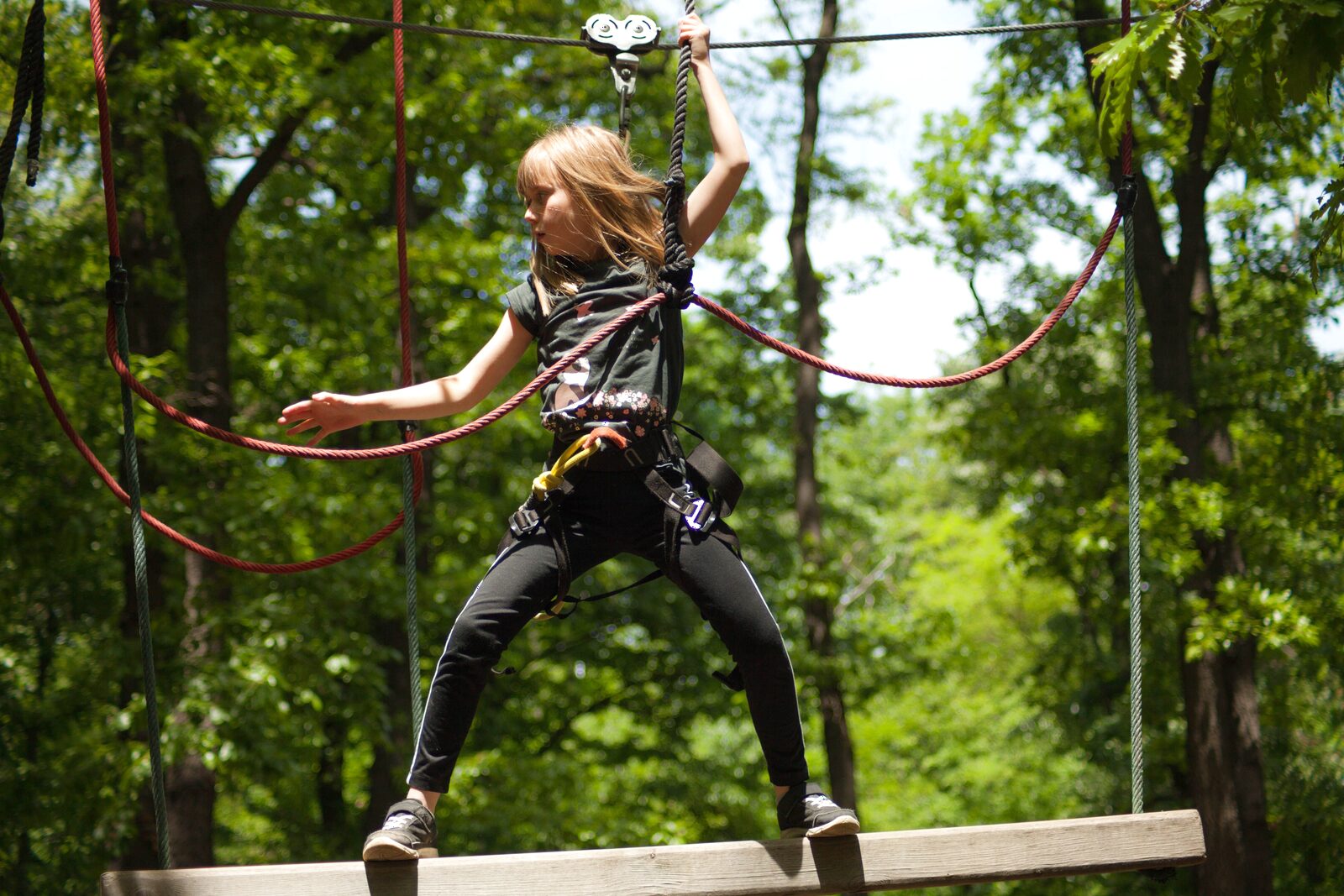
This directory records 79 high ropes courses, climbing parks and forest rope parks in Austria, plus twelve in Slovenia. They range from a pedagogically run site with two dozen stations to a large operation with 22 courses. This article sorts the field: where the term comes from, which sites stand where, what they cost – and how to tell which kind of high ropes course you are dealing with.
Where the high ropes course comes from
The first high ropes courses were not built as a day out but as a teaching tool. In the 1970s and 1980s schools, youth work and later companies adopted a concept from outdoor education: walking a swaying beam eight metres up puts you at your own limit immediately – and shows the role of the group belaying and calling from below.
Only later did leisure operation follow. Today many sites labelled "Hochseilgarten" work as ordinary public parks: you buy a ticket and climb on your own. How that works is explained in the piece on the climbing park.
High ropes courses in Austria by province
The distribution follows tourism, not population: Tyrol has more than six times as many sites as Vorarlberg. The price in the table is the median adult ticket among the sites in that province for which we hold a price.
| Province | Sites | Adults (median) | A well-known site |
|---|---|---|---|
| Tyrol | 21 | 29.50 € | Kletterpark Schlossberg Lienz |
| Styria | 13 | 30 € | Abenteuerpark Gröbming |
| Carinthia | 12 | 29 € | Adventurepark Gerlitzen |
| Lower Austria | 8 | 31.50 € | Kletterpark Wartmannstetten |
| Upper Austria | 8 | 30 € | Hochseilgarten Hinterstoder |
| Salzburg | 8 | 29 € | Hochseilpark Saalbach-Hinterglemm |
| Burgenland | 3 | 25 € | Hochseilgarten Stegerspark |
| Vorarlberg | 3 | 29 € | Waldseilpark Golm |
| Vienna | 3 | 34.50 € | Waldseilpark Kahlenberg |
Two caveats. In Vienna only two of the three recorded sites are still running – the Hochseilgarten Donauinsel is gone and its operator now runs the Gänsehäufel. And Hochseilpark Böhmerwald, otherwise the largest in Upper Austria, was closed through 2026 for rebuilding; in August 2026 its operator told us it will probably not be rebuilt at all, which is why it is no longer listed here. Check the current state with the operator before every trip – the link is on each detail page.
The most striking sites in the country
- The largest: Abenteuerpark Gröbming in Styria – 22 courses, around 200 stations and more than 2,000 metres of climbing on 20,000 m².
- The highest point: Hochseilpark Nockberge in Carinthia reaches 27 metres, matched by the climbing tower at AREA 47 in Tyrol. Most sites stop at 15 to 18 metres.
- The most zip lines: Adventurepark Gerlitzen with 31 flying foxes, followed closely by Vienna's Gänsehäufel with 26.
- The most versatile for families: Kletterpark Schlossberg Lienz – 18 courses, around 200 elements, and children climbing near the ground from the age of two.
- The easiest to reach: Waldseilpark Kahlenberg lies inside the Vienna city limits and is reachable by public transport – 15 courses, partly 20 metres up in the trees.
If size is what you are after, there is more in the largest climbing parks in Austria.
How to recognise a pedagogically run site
- Booking instead of a ticket desk. Dates by arrangement, often for groups only.
- An instructor comes along rather than briefing you and watching.
- Reflection. The exercise is not the goal but the occasion for the conversation afterwards.
- Low ropes elements. Tasks just above the ground the group has to solve together, without a harness.
Several Austrian sites work this way. Hochseilgarten Puchberg at the foot of the Schneeberg caters to companies, apprentice groups and school classes rather than spontaneous family visits. Hochseilgarten am See in the Mostviertel opens for groups by telephone arrangement and even brings mobile elements to the client.
The OeAV centre in Mauthen belongs to the Alpine Club and is mostly used for courses, while Schloss Retzhof in southern Styria is part of an education centre – and barrier-free.
What separates team training from a day out
On a leisure visit everyone picks a course and walks it. In team training the instructor sets tasks you cannot solve alone: a platform everyone has to fit on, a crossing where one person needs another's hand.
Climbing is the means, not the purpose. Such programmes usually take half a day or a full day and cost more per person than a ticket – in return you get supervision, not just access.
For companies and schools one more thing matters: the supervision ratio is regulated and the instructors are trained for the target group. Anyone booking a school class should ask about it.
Safety: standard, inspection, belay system
Austrian high ropes courses are built and operated to the European standard EN 15567: part 1 covers the structure, part 2 operation including recurring inspection by qualified persons. Waldseilpark Tscheppaschlucht names it explicitly; most others take it for granted.
In practice the belay system matters more than the standard. Sites with a continuous belay – SafetyLine, Safety-Line, Speedrunner – make unclipping impossible: clip in once, stay clipped in to the end of the course. Kletterpark Schöckl advertises this as the highest safety level of the standard. Older sites use two carabiners you move over; modern versions of that (Smart Belay) block opening both at once.
For parents this is the single most important criterion when choosing a site – more important than height, course count and price.
Height is not a quality mark
Because the German word contains "high", height is easily overrated. For the experience it is secondary: at eight metres a swaying beam feels much like it does at sixteen – your stomach decides that, not the tape measure.
Range matters more. Sites like Waldseilgarten Natrun with seven courses from one to 16 metres, or Hochseilgarten Stegerspark in Burgenland with elements between one and 23 metres, let everyone start where they feel comfortable.
Season and prices
The season follows the weather: most Austrian sites start in May – a few in April – and close in October. In the shoulder months many open at weekends only; daily operation is usually limited to July and August.
On price, the median across all Austrian sites is 29 € for adults and 19 € for children. The range is wide: 13 € at Waldkletterweg Faistenau, 54 € at Waldseilpark Pfunds. It gets expensive wherever a mountain railway or a combined ticket is attached – at Golm the combination with railway, coaster and slide park costs 62 €.
And if you just want to climb?
Then a public park is the right choice – and that is what most of the 91 sites in our directory are. On the home page they can be filtered by region, by the child's age and by opening day.
Frequently asked questions about high ropes courses
How many high ropes courses are there in Austria?
This directory records 79 sites in Austria plus twelve in Slovenia. Most are in Tyrol (21), Styria (13) and Carinthia (12). There is no official total, because small club and school installations are not registered centrally anywhere.
What is the difference between a high ropes course and a climbing park?
Linguistically usually none. Historically the high ropes course comes from experiential education: instructors, groups, reflection after the exercise. The climbing park is a public operation with a ticket desk where you climb on your own after a briefing. Many sites carry the older name and have long worked as public parks.
What does a high ropes course cost in Austria?
29 € for adults and 19 € for children on median. Cheap sites start at 13 €, the most expensive charge up to 54 €. Equipment – harness, helmet, belay set – is almost always included; the mountain railway and gloves often are not.
When are high ropes courses open?
Most Austrian sites open in May and close in October, frequently at weekends only in spring and autumn. A few have a far shorter season, such as Kletterpark Piber from early July to mid-September.
Is a high ropes course suitable for a company outing?
Yes – but not every one. Real team training needs a site with trained instructors, low ropes elements and time for reflection afterwards, as in Puchberg, Mauthen or at Retzhof. A public park suits a sociable day out, not team development.
How safe is a high ropes course?
Construction and inspection follow EN 15567, and many sites add a continuous belay that makes unclipping technically impossible. The main residual risk is not falling but overestimating yourself: lose your strength on too hard a course and you hang there waiting to be recovered. Which is why you start at the bottom and work your way up.